High Quality Materials
Good reputation over the world.

Testing Report

category
2017-02-16

Sunny Head Bimate vs. Other Brand Chipboard Screws

Sunny Head Bimate vs. Other Brand Chipboard Screws

This R&D study case compares Bimate Screw with other brand chipboard screws through breaking torque, pull-out force, drilling-in torque, bending angle, and flatness testing. The purpose of this comparison is to help buyers understand how chipboard screw design may affect fastening strength, labor saving, wood surface flatness, bending resistance, and installation quality.

The testing was conducted as project RDT09001-20-1, dated 2009/09/17. The product size in this test is 4.0 x 40. The tested samples include Bimate Screw and other chipboard screw samples for mechanical property comparison.

Test Samples

  • A: Bimate Screw
  • B: Sxx screw
  • C: Standard Chipboard screw
  • D: Rxx

Testing Items

  • Breaking torque
  • Pull-out force
  • Drilling-in torque
  • Bending angle
  • Flatness

Breaking Torque Test

Breaking torque testing helps compare screw mechanical strength. The original report notes that testing results are for reference and are related to bending angle. A higher breaking torque may indicate a stronger but more brittle screw, while a higher breaking torque may also correspond to a smaller bending angle.

Breaking Torque A B C D
#1 40 45 37 33
#2 40 45 37 34

Pull-Out Test

The pull-out test evaluates the holding ability after screws are assembled into wood. A higher pull-out value indicates stronger gripping force and better fastening security. The original testing result ranking is A > B > C > D.

Pull Out (kN) A B C D
#1 5 4.5 4.5 4
#2 5.5 4.8 4.2 4.2

Drilling-In Torque Test

Drilling-in torque testing measures the maximum torque value after drilling whole screws into benchwood. A smaller drilling-in torque can help reduce installation effort and support labor-saving performance. The original testing result ranking is A = B > C > D.

Drilling-In Torque (N-m) A B C D
#1 1.29 1.28 1.44 1.51
#2 1.21 1.23 1.42 1.49

Bending Angle Test

The bending angle test evaluates whether the screw can resist bending, popping off, or breaking when affected by outside force. Wood may twist or deform due to environmental conditions such as earthquakes, heavy rain, sunshine, wind, and other natural changes. A higher bending angle can support safer installation and better resistance against outside force.

Sample A B C D
Bending Angle 50° 30° 35° 30°

According to the original testing report, the bending angle result is A > C > B = D. Sample A showed the highest bending angle in this comparison, supporting better resistance to bending and outside force in the demonstrated test.

Flatness Test: Drilling into Benchwood and Drilling Out

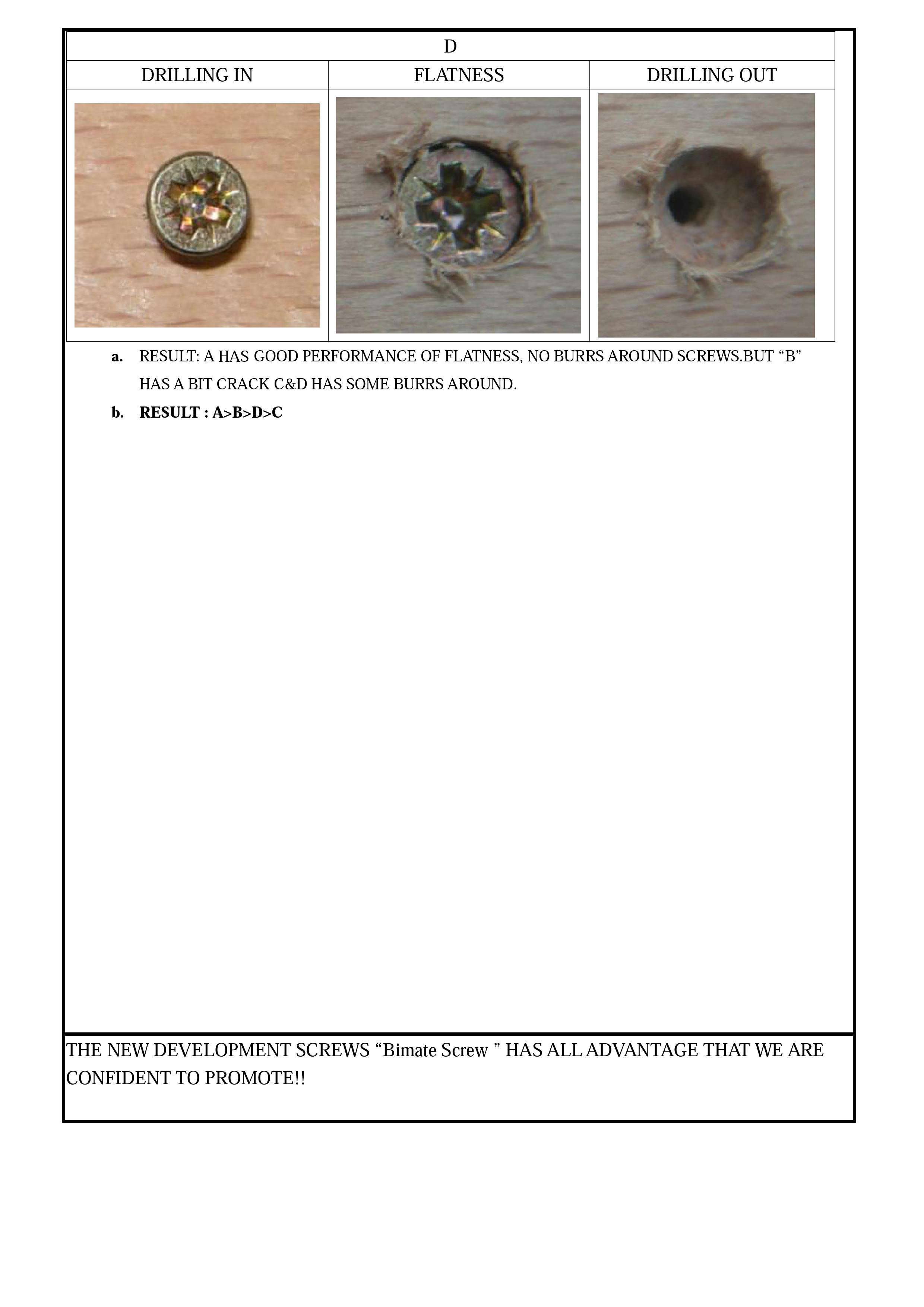
The flatness test compares screw performance after drilling into benchwood and removing the screw. The test observation includes drilling in, flatness after fastening, and drilling out. These observations help evaluate whether the screw creates burrs, cracks, or uneven surface conditions around the fastening area.

  • Test material: Benchwood.
  • Test observation: drilling in, flatness, and drilling out.
  • Evaluation focus: surface flatness, burrs around the screw head, wood cracking, and drilling-out condition.

According to the original testing report, sample A showed good flatness performance with no obvious burrs around the screw after drilling. Sample B showed a small crack, while samples C and D showed some burrs around the drilled area. The original result ranking shown in the report is A > B > D > C.

This testing report demonstrates Taiwan Shan Yin's R&D testing approach for Bimate Screw, chipboard screws, wood screws, and customized fastening solutions. Through breaking torque, pull-out force, drilling-in torque, bending angle, and flatness comparison, buyers can better understand how screw design affects installation effort, grip performance, bending resistance, wood surface condition, and fastening quality.

Sunny Head Bimate versus other brand chipboard screws R&D study case showing test samples, breaking torque, pull out, and drilling-in torque results

Bending angle test for Sunny Head Bimate and other brand chipboard screws showing sample A with 50 degrees, sample B with 30 degrees, sample C with 35 degrees, and sample D with 30 degrees

Flatness test for Sunny Head Bimate and other chipboard screws drilling into benchwood with drilling in, flatness, and drilling out comparison

Sunny Head Bimate screw flatness result showing good performance with no obvious burrs around the screw after drilling

Tag: